
Connecting to country at Uluru
You want to do what?!
My husband’s reaction was to be expected. The combination of words I’d just said were highly unusual for me: Uluru, women’s retreat, camping. I don’t like hot weather. I don’t camp, ever. And I’ve never been on a retreat. Also, since losing my vision, I’d never travelled on a plane alone. I’d only flown with my husband or a friend or a colleague.
What about the snakes? My husband asked.
A panic attack seemed more likely than a snake bite. I explained I’d found this company, run by a woman who seemed confident she’d be able to make the trip work for me. I said I was excited that the retreat involved a strong focus on the local Traditional Owners.
So, in September 2026 my plane touched down in Uluru. By this stage my husband was hugely supportive. As always, when I decide I’m going to do something difficult, something that takes courage, he propels me forward. Iris Ray Nunn, founder of Deep Listening to Nature, met me at Uluru airport – the first of many thoughtful things she did to support me during this trip. I soon learned that Iris has an extraordinarily big heart. She’s an accredited Uluru guide – although she is so much more than that title conveys. I saw the way Iris works with and is trusted by members of the local Traditional Owners – the Aṉangu (pronounced arn-ung-oo). For those lucky enough to go on her retreats, Iris opens the door to a greater comprehension of Aṉangu lore and story (Tjukurpa). She helps you grasp what it means to truly live in connection to country, with all the personal responsibility that these ways of being both demand of you and ground you. So many First Nations people have talked to me about being in two worlds – the world of their own culture and lore and the world of settler laws and systems. Iris is a person who literally creates a bridge between these two worlds.
At Watarrka National Park or Kings Canyon, about three hours drive from Uluru, our group of five women faced a famously difficult and dangerous climb – straight up, no railings and the track is lined with defibrillators! At eight in the morning the day already felt baking hot, which I guess you might expect in the desert. Iris conducted a risk assessment. Very grateful, I ended up tackling the climb a less hazardous way, holding onto Iris’ backpack, or hand, or arm, with every single step. She described the ochre, purple and mauve rock of the canyon, the dark and lime green of the grasses, and the pink and grey of tree trunks. She even described a brightly coloured stinkbug. We listened to the birds calling us and the crunch of the craggy, uneven stones beneath our feet. And yes, it did totally suck not being able to see it. But then in the midst of the harsh glare, I saw ripples in the slate in front of me. This place was once an inland sea. Here was the imprint of the water. I traced my hands across the wavy lines and felt the sun-warmed stone.
The next leg of our trip was at the Uluṟu-Kata Tjuṯa National Park. We set up our tents in the campground located in the small township nearby. In the name of teamwork the lovely women patiently let me try to help with this task!
At Kata Tjuṯa (the Olgas) once again I held onto Iris’ arm, hand or backpack for our early morning walk, the path being made up of scattered and jagged stones. Sudden roaring winds bore down on us and then faded away to stillness, depending on which section of the walk we were passing through. When we reached our destination – a viewing platform - a few of us lay on the ground and stared up. The colour was so saturated, I could see the bright blue sky, the deep throbbing orange of the stone to one side and then blackness, which was the rock in shadow on the other side. It’s unusual for me to be able to see colour so clearly but this was stark as a Mondrian painting, only much more beautiful. We listened to the soft breeze, and the sound of our own breathing. Then we let rip with a coooweee which ricocheted all around that ancient special place.
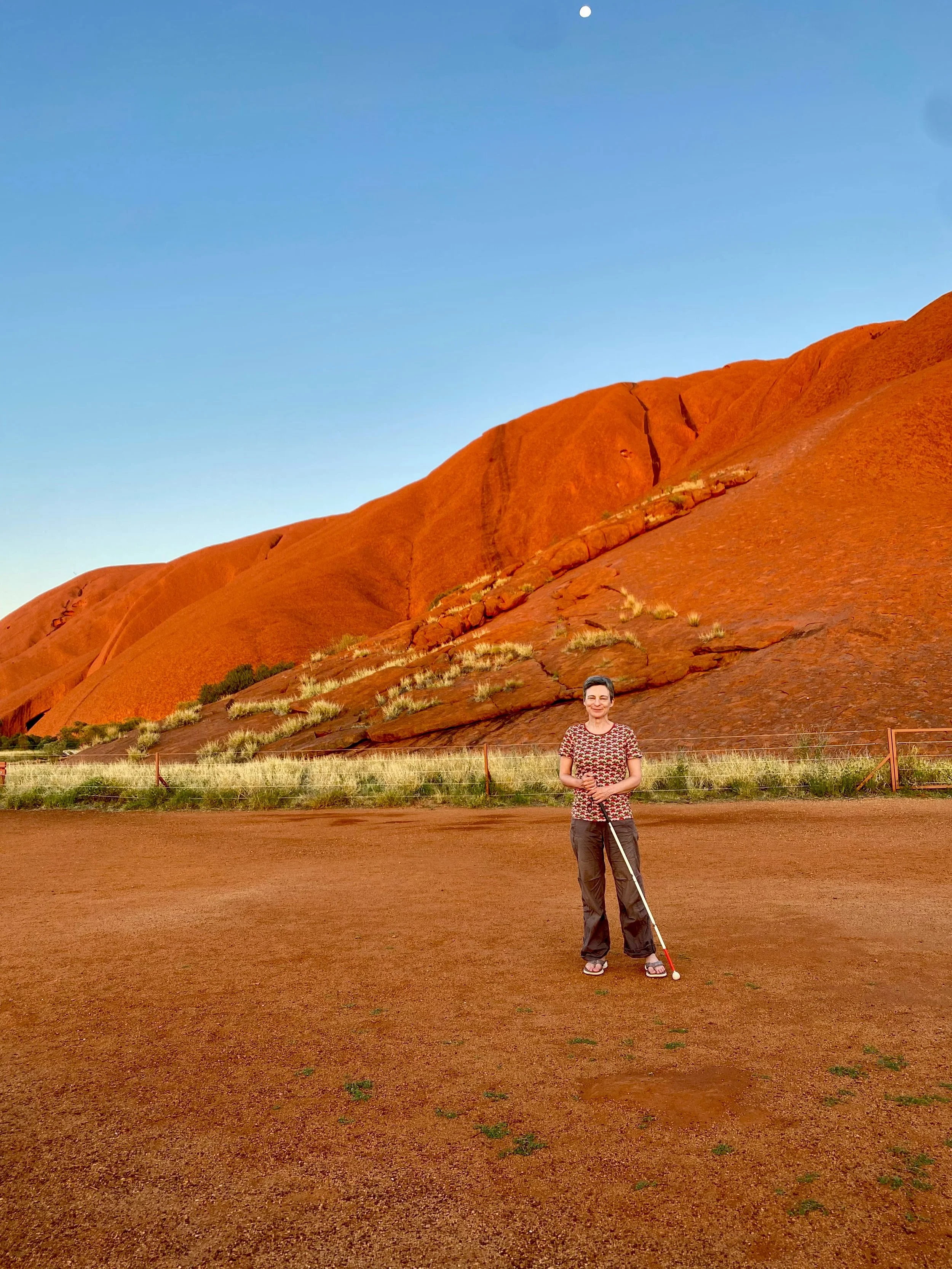
At Uluru we explored the ever-changing façade of the rock from myriad vantage points, red sand fine as silk beneath our feet. We spent time at the cultural centre and met Evelyn Ailek, an Aṉangu artist and cultural guide. She told us many things, including a Tjukurpa story that every woman should hear.
It was a week of cultural immersion, sisterhood and physical challenges, our knowledge and understanding building up layer by layer, step by step, breath by breath. Throughout the retreat Iris made sure we had access to plenty of water, good food and coffee. Whether that be at a café, in our own provisions, or meals she created. Think delicious and perfectly cooked porridge whipped up out of the back of the car at sunrise with a view across to Uluru. Or a big vegie bake on the campfire. Or pasta at sunset at Uluru before a dusk walk under the rising moon. And we all understood the National Park rules around when we needed to depart and leaving no trace of ourselves behind.
Iris also made sure that wherever I was sleeping it was close to the bathrooms and other amenities so it would be as easy as possible for me to navigate independently. It’s a rare person who understands intuitively how to do this. I felt utterly safe and empowered throughout this trip by Iris and the other wonderful women on the retreat.
The Aṉangu ask you to listen carefully when visiting Uluṟu-Kata Tjuṯa National Park. They say: Let the knowledge you hear come through your ears, into your mind, and settle in your heart. Thanks to Iris Ray Nunn and the women I shared this experience with, I feel I was able to properly honour this gentle request.